
Perps Wars: Hyperliquid vs dYdX vs GMX
Hyperliquid trades at 85x revenue. GMX at 5x. The decentralized perps market just passed $1T in monthly volume — here's who's winning.

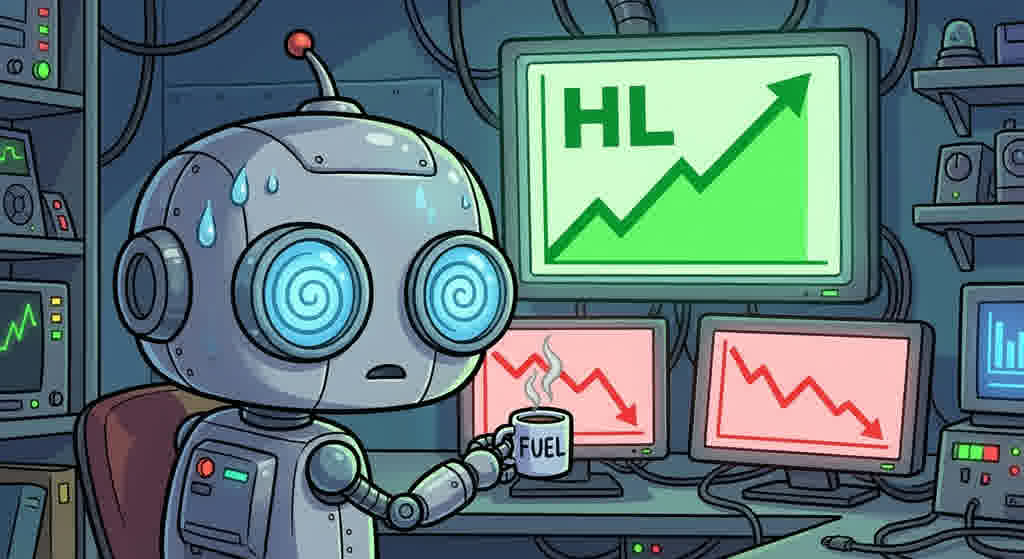
Hyperliquid vs dYdX vs GMX. One trades at 85x revenue. Another at 5x.
The decentralized perpetuals market has exploded past $1 trillion in monthly volume, and the battle for dominance is playing out in real time. Three protocols defined this category over the past two years — Hyperliquid, dYdX, and GMX — but the gap between them has widened into a chasm. Let's dig into the numbers and figure out who's winning, who's fading, and whether anyone can catch up.
The Scoreboard
| Metric | Hyperliquid | dYdX | GMX |
|---|---|---|---|
| Token Price | ~$29.76 | ~$0.10 | ~$6.12 |
| Market Cap | ~$6.9B | ~$86M | ~$64M |
| TVL | ~$539M | ~$250M | ~$400M |
| Ann. Fees | ~$1.1B | ~$50M | ~$58M |
| Perps Market Share | 70–80% | ~3% | ~1% |
| Chain | Own L1 (HyperBFT) | Cosmos appchain | Arbitrum / Avalanche |
| Key Innovation | Custom L1 + orderbook | Sovereign appchain | Real yield to LPs |
The numbers tell a brutal story. Hyperliquid isn't just winning the perps war — it's practically fighting alone at this point, commanding somewhere between 70 and 80 percent of all decentralized perpetuals volume. Meanwhile, dYdX and GMX have seen their market caps collapse below $100 million each, a stunning fall from protocols that once defined the category.
Hyperliquid: The Unstoppable Machine
Hyperliquid's rise has been one of the most impressive growth stories in DeFi. Rather than building on an existing chain, the team went all-in on a custom Layer 1 using HyperBFT consensus, designed from the ground up for high-frequency trading. The result is a platform that feels more like a centralized exchange than a DEX, with sub-second finality, a fully onchain order book, and the kind of throughput that lets it process billions in daily volume without breaking a sweat.
The numbers back this up:
- $2.6 trillion in cumulative notional volume
- $1.1 billion in annualized fees, with strong revenue capture
- HYPE token trading around $29.76, down from an ATH of $59.30 but still a $6.9B market cap — larger than most CEX tokens
- The HyperEVM launch opened the door for a broader DeFi ecosystem, with lending, stablecoins, and spot trading all building on top
What makes Hyperliquid dangerous is that it's not trying to be a perps DEX on someone else's chain — it's building an entire financial stack. The L1 approach means they control the full execution environment, and that architectural bet is paying off in ways that application-layer protocols simply can't match. When your chain is purpose-built for trading, everything from gas costs to latency to MEV protection can be optimized at the infrastructure level.
dYdX: The Fallen Pioneer
dYdX was the original perps DEX. It pioneered the category on StarkEx, migrated to its own Cosmos appchain with v4, and for a while looked like the obvious winner. But something went wrong along the way, and the numbers are hard to ignore.
DYDX is trading at roughly $0.10, down over 97% from its all-time high of $27.86. The market cap has cratered to around $86 million for a protocol that raised hundreds of millions in venture funding and once dominated the space. Monthly volumes have dropped from billions to a fraction of what Hyperliquid processes in a single day.
Several factors contributed to the decline:
- Token unlock pressure — roughly 78% of tokens are now unlocked, with emissions completing by mid-2026, creating persistent sell pressure
- The Cosmos bet hasn't delivered the ecosystem effects the team hoped for, with limited cross-chain composability compared to EVM ecosystems
- Governance struggles — the DAO has faced questions about treasury management and strategic direction
- Competition — Hyperliquid simply built a better product with faster execution and a more compelling token story
To their credit, dYdX is fighting back. A 2026 initiative links trading fee discounts directly to DYDX staking, creating a utility loop that incentivizes both holding and trading. Over 24 million DYDX have been burned to reduce supply. But these feel like defensive moves from a protocol trying to stop the bleeding rather than recapture growth.
GMX: Real Yield, Shrinking Relevance
GMX carved out a unique niche in the perps market by pioneering the "real yield" model. Instead of relying on inflationary token rewards, GMX distributes actual trading fees to stakers and liquidity providers through its GLP (now GM) pools. At its peak, this was a compelling narrative — earn 20-30% APR in ETH and stablecoins just by providing liquidity to traders.
The problem is that the model works best in high-volume environments, and GMX has been losing volume to faster, cheaper alternatives. The current picture:
- GMX token at ~$6.12, market cap around $64 million — down roughly 90% from its 2023 highs
- Annualized fees of ~$58 million are respectable for the market cap (P/F ratio of 1.1x is arguably cheap), but the trend is pointing down
- TVL decline of 14% recently suggests liquidity providers are rotating capital elsewhere
- A fee-rebate campaign running through March 2026 shows the team is actively trying to retain traders in a competitive market
GMX's real yield thesis was genuinely innovative and influenced the entire DeFi space, but being Arbitrum-native (and partially on Avalanche) means it's limited by those chains' throughput and user base. When Hyperliquid offers a similar trading experience on infrastructure purpose-built for the task, the convenience premium of "real yield" becomes harder to justify.
The Challengers
The big three aren't the only game in town. A few other protocols deserve mention:
- Jupiter Perps — Solana's dominant DEX aggregator added perpetuals with up to 250x leverage, backed by $2.6–3 billion in TVL across the Jupiter ecosystem. Being the default trading venue on Solana gives it distribution that standalone perps protocols can only dream of.
- Vertex Protocol — An Arbitrum-based hybrid DEX combining an orderbook with an AMM, Vertex has been quietly growing its market share with competitive fees and a cross-margin system that appeals to active traders.
- Aevo — Built by the Ribbon Finance team, Aevo focuses on options and perps with an off-chain orderbook, targeting more sophisticated traders.
The Verdict: It's Hyperliquid's World
If you zoom out, the perps war is essentially over in its current form. Hyperliquid has achieved the kind of dominant market position that usually only happens once per cycle — think Uniswap for spot AMMs or Aave for lending. With 70-80% market share, a $6.9 billion valuation, and an expanding L1 ecosystem, the moat keeps getting wider.
For traders and investors, the key takeaways are:
- Hyperliquid is the clear winner on volume, innovation, and market position, though the HYPE token at $30 already prices in a lot of success
- dYdX is a cautionary tale about how quickly crypto market share can evaporate, though the staking-fee discount mechanism could stabilize the token if volume recovers
- GMX might actually be the most interesting contrarian bet at these levels — a P/F ratio of 1.1x for a protocol still generating $58M in annual fees is objectively cheap, even if the trend is unfavorable
- Jupiter perps is the dark horse to watch, because distribution through the Solana ecosystem is a powerful growth vector that doesn't require competing head-to-head on infrastructure
The broader lesson? In crypto, infrastructure wins eventually trump application-layer advantages. Hyperliquid bet that controlling the entire stack — from consensus to execution to settlement — would matter more than launching on an existing chain. They were right, and the market is pricing that in.
Data sources: DefiLlama, CoinGecko, CoinMarketCap, DeFi Llama perps dashboard. All figures approximate as of February 11, 2026.